
If you have oak trees over your roofline, you already know gutter problems are not just about a few leaves in the fall. Oaks drop long catkins in spring, small leaf pieces through summer, full leaves in fall, and acorns when you least want them hitting your gutter system. That is why choosing the best gutter guards for oaks takes more than grabbing the cheapest screen at a store and hoping for the best.
Oak debris is stubborn. It mats together, breaks apart into smaller pieces, and tends to sit on top of weak guards or slip through openings that looked small enough on paper. The right guard has to do two jobs well. It needs to keep debris out, and it needs to move water reliably during a hard Indiana or Ohio rain.
What makes oak trees so hard on gutters
Some trees are mostly a leaf problem. Oaks are more complicated. Their leaves are often broad and curled, which means they can pile up and bridge over openings. Their catkins are stringy and messy, and they have a way of clinging to rough surfaces or tangling across screens. Acorns add another issue because they are heavy enough to dent weaker materials and can lodge in places where debris starts to build.
That combination matters because a gutter guard that works fine under a maple or a small ornamental tree may struggle badly under mature oaks. A guard with large holes can let fragments and tassels in. A guard with flat sections can collect wet debris. A lightweight insert can sag or shift when acorns and heavy leaf loads hit it.
For most homes with oaks nearby, the best results come from guards that are securely fastened, made from durable metal, and designed to shed debris off the edge instead of simply catching it on top.
Best gutter guards for oaks: what to look for
Start with strength. Oak debris is heavier than many homeowners expect, especially when it gets wet. Thin plastic guards and loosely fitted foam inserts usually do not hold up the way people hope. They may look like a quick fix, but they often become a maintenance item of their own.
Next, pay attention to opening size and surface design. Very large openings invite trouble from catkins, seed debris, and broken leaf pieces. Very fine mesh can work in some situations, but it depends on roof pitch, water volume, and how the guard is installed. Under heavy tree cover, the goal is not just filtration. The goal is controlled water flow with minimal buildup.
Attachment method also matters. Snap-in products can shift. Brush and foam styles sit inside the gutter, which means debris still collects in the gutter channel even if the top looks covered. For oak-heavy properties, a professionally installed system that reinforces the gutter and creates a solid, continuous barrier tends to perform better over time.
The main gutter guard types and how they handle oak debris
Mesh guards
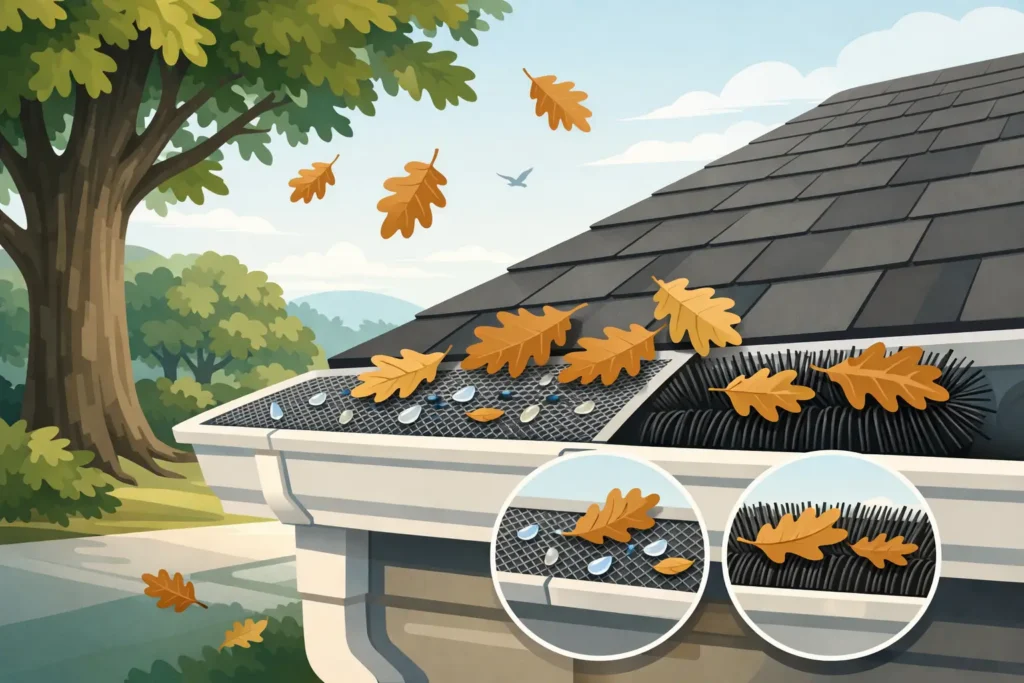
Mesh guards are a common choice because they aim to block small debris while letting water pass through. Some perform well, especially when the material is rigid and the installation is precise. But not every mesh product is the same.
Under oak trees, lower-end mesh can become a landing pad for wet leaf fragments and catkins. Once that layer forms, water may start to run over the front edge during heavier storms. Better mesh systems reduce that risk with stronger construction and a profile that encourages debris to dry out and blow away. Even then, some homes with very dense oak coverage still need occasional brushing off at the surface.
Reverse curve or surface tension guards
These guards use water adhesion to pull rain into the gutter while encouraging leaves and larger debris to slide off. In the right setup, they can do a good job with full leaves and acorns. The trade-off is that performance depends heavily on roof slope, gutter placement, and installation quality.
With oaks, reverse curve systems can struggle if small debris gets into the entry slot or if runoff overshoots during hard rains. They are not automatically a bad option, but they are less forgiving when conditions are not ideal.
Screen guards
Basic screens are widely available and often inexpensive. They can block larger leaves, but they are usually not the best gutter guards for oaks if your goal is long-term protection. Oak catkins and smaller leaf pieces can get through or sit on top and create buildup. Many screen products also lack the structural strength needed for heavy seasonal debris loads.
For homeowners trying to reduce cleaning without replacing the problem with a different one, standard screen guards are often a short-term answer.
Foam and brush inserts
These are usually the least effective option around oaks. Foam can trap grit, pollen, shingle granules, and organic material inside the gutter. Brush inserts catch leaves and tassels in the bristles. Both can turn routine maintenance into a messy removal job.
They may sound simple, but simplicity is not the same as reliability. If you have mature oaks around your home, these options usually create more frustration than protection.
Continuous-hanger aluminum systems
For homes dealing with repeated oak debris, this is often the strongest category to consider. A continuous-hanger aluminum guard adds support to the gutter while covering it with a solid, durable leaf protection system. Instead of acting like a loose accessory, it becomes part of the gutter structure.
That matters because oak conditions are demanding. A stronger system helps prevent sagging, handles impact from acorns better, and gives debris fewer places to settle. Products in this category are typically better suited for homeowners who want fewer cleanings and a more durable long-term fix rather than a bargain solution that may need replacement.
Why installation quality matters as much as the guard itself
A good product installed poorly can still fail. That is especially true with oaks, where debris finds weak points quickly. If a guard is pitched wrong, attached unevenly, or installed over existing gutter issues, you may still end up with overflow, standing water, or hidden clogs.
This is one reason a free inspection is valuable before choosing a system. The condition of the fascia, the size of the gutter, the roof edge, the number of valleys, and the amount of tree coverage all affect what will work best. A homeowner with one oak near the back corner of the house has a different problem than someone with multiple mature oaks hanging over most of the roof.
An honest estimate should also explain what is being installed and why. If a contractor only talks about the guard and ignores the condition of the gutters holding it, that is a red flag.
The best fit for most oak-heavy homes
For many homes in Eastern Indiana and Western Ohio, the best answer is a professionally installed aluminum leaf protection system that is built to stay in place, support the gutter, and shed debris effectively. That is why many homeowners lean toward premium continuous-hanger options instead of store-bought inserts or light screens.
Seamless Gutter Solutions LLC installs Double Pro by Alurex, a premium continuous-hanger gutter guard designed for durability and strong water handling. For homes dealing with oak leaves, catkins, and acorns, that kind of system makes sense because it is built as a structural upgrade, not just a cover placed on top of an existing problem.
That does not mean every home needs the same exact setup. Some rooflines need repairs first. Some gutters are undersized or pulling away already. And some homes under extreme tree cover may still need occasional maintenance. A trustworthy recommendation should account for those details instead of promising a zero-maintenance miracle.
How to decide without wasting money
If you are comparing options, think in terms of total cost over time, not just purchase price today. A cheap guard that still requires frequent cleaning, shifts out of place, or contributes to overflow can cost more in the long run than a stronger system installed correctly the first time.
Ask practical questions. Will this guard handle small oak debris, not just full leaves? Is it secured well enough for heavy weather and acorn impact? Will it improve the gutter’s strength or just sit on top of it? And if your existing gutters are not in great shape, is the quote addressing that clearly with no vague add-ons later?
The right contractor should be comfortable giving direct answers, explaining trade-offs, and putting the details in writing. That kind of transparency matters when you are protecting your roof edge, siding, landscaping, and foundation from water damage.
Oak trees are beautiful, but they are hard on gutters. If your current setup clogs every season or spills water where it should not, the fix is usually not more cleaning. It is choosing a gutter guard system that is actually built for the kind of debris your property deals with every year.