
You know that sound when a summer storm hits hard and fast – and suddenly your gutters sound like a waterfall. If you have gutter guards (or you are thinking about them), the big question is simple: do gutter guards work in heavy rain, or do they turn your gutter system into an overflow problem?
They can work very well in heavy rain, but only under the right conditions. Heavy downpours don’t just test the guard. They test the entire system: gutter size, downspout capacity, slope, hanger strength, roof runoff speed, and whether debris is restricting flow. A good guard should keep leaves and roof grit out while letting water in quickly. A poor match or a poor install can make overflow more likely.
Do gutter guards work in heavy rain?
Yes – if they are designed to accept high volumes of water and your gutter system is built to move that water away fast.
In Eastern Indiana and Western Ohio, heavy rain often comes with wind, tree debris, and roof runoff that hits the gutter edge at speed. In that scenario, gutter guards generally succeed or fail for one of two reasons.
First is water acceptance: can the guard surface pull water into the gutter instead of letting it shoot over the edge? Second is drainage capacity: once the water is inside the gutter, can it move to the downspouts without bottlenecking?
A guard can do its job and you can still get overflow if the gutter is undersized, the slope is off, or the downspouts are too few for the roof area. That’s why “gutter guard performance” is really “whole-system performance.”
What heavy rain actually does to your gutter system
A normal rainfall is forgiving. A heavy downpour isn’t.
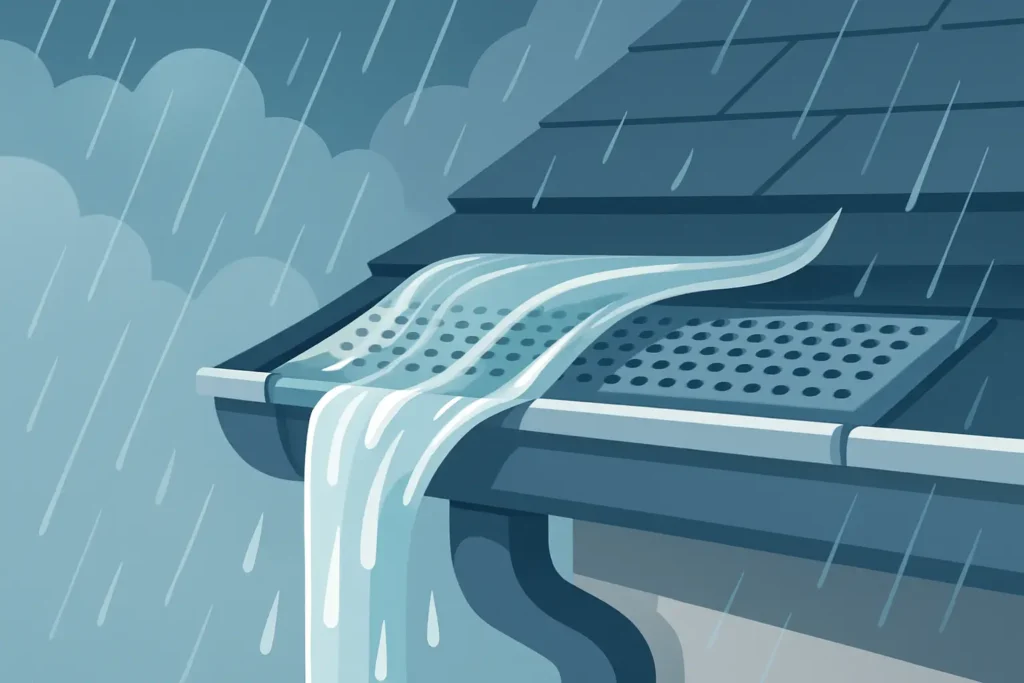
When rainfall intensity spikes, roof water doesn’t politely trickle into the gutter. It sheets down the shingles and can jump the gutter line, especially on steep roofs. Add wind and the water can hit at an angle, pushing it toward the outer edge instead of straight down into the trough.
At the same time, the gutter has to carry more water, faster. If the gutter is even slightly backpitched, sags between hangers, or has a downspout that’s partially restricted, you get a backup. That backup rises to the top of the gutter and finds the easiest exit – often right over the front lip, which looks exactly like “the guards aren’t working.”
The gutter guard designs that handle downpours best
Not all gutter guards are built for high-volume flow, and “one-size-fits-all” is where homeowners get burned.
Micro-mesh systems are popular because they block small debris, but the mesh has to be engineered for both filtration and flow. High-quality micro-mesh can handle heavy rain well, especially when it’s paired with a solid frame that keeps the mesh flat and properly angled. Cheaper versions can struggle when they get coated with pollen, shingle grit, or fine roof sediment because the effective openings shrink.
Perforated aluminum guards (with punched holes) can move a lot of water, but they also let in smaller debris that can build up inside the gutter over time. In heavy rain, they usually accept water well – the bigger risk is what happens months later when the gutter interior starts to load up.
Surface-tension or “helmet-style” guards are the most sensitive to roof edge conditions and rain intensity. They rely on water clinging to a curved nose and rolling into a slot. In a serious downpour, or when water is moving fast off a steep roof, some of that water can overshoot. They can work, but they tend to be less forgiving if the roofline, pitch, and installation angles aren’t just right.
Brush and foam inserts are the least reliable in heavy rain because they sit inside the gutter and can become the restriction. When they collect grit and organic material, they reduce capacity right where you need it most.
Why some guarded gutters overflow in heavy rain
Most overflow complaints come down to a handful of real-world issues – and they’re fixable.
The gutter is too small for the roof
Many homes in our area still have 5-inch gutters and minimal downspouts. That can be fine on smaller roof sections, but larger roof planes and fast runoff can overwhelm the system. If the gutter can’t carry the volume to the downspout quickly enough, water rises and spills, guard or not.
Not enough downspouts (or the wrong downspout layout)
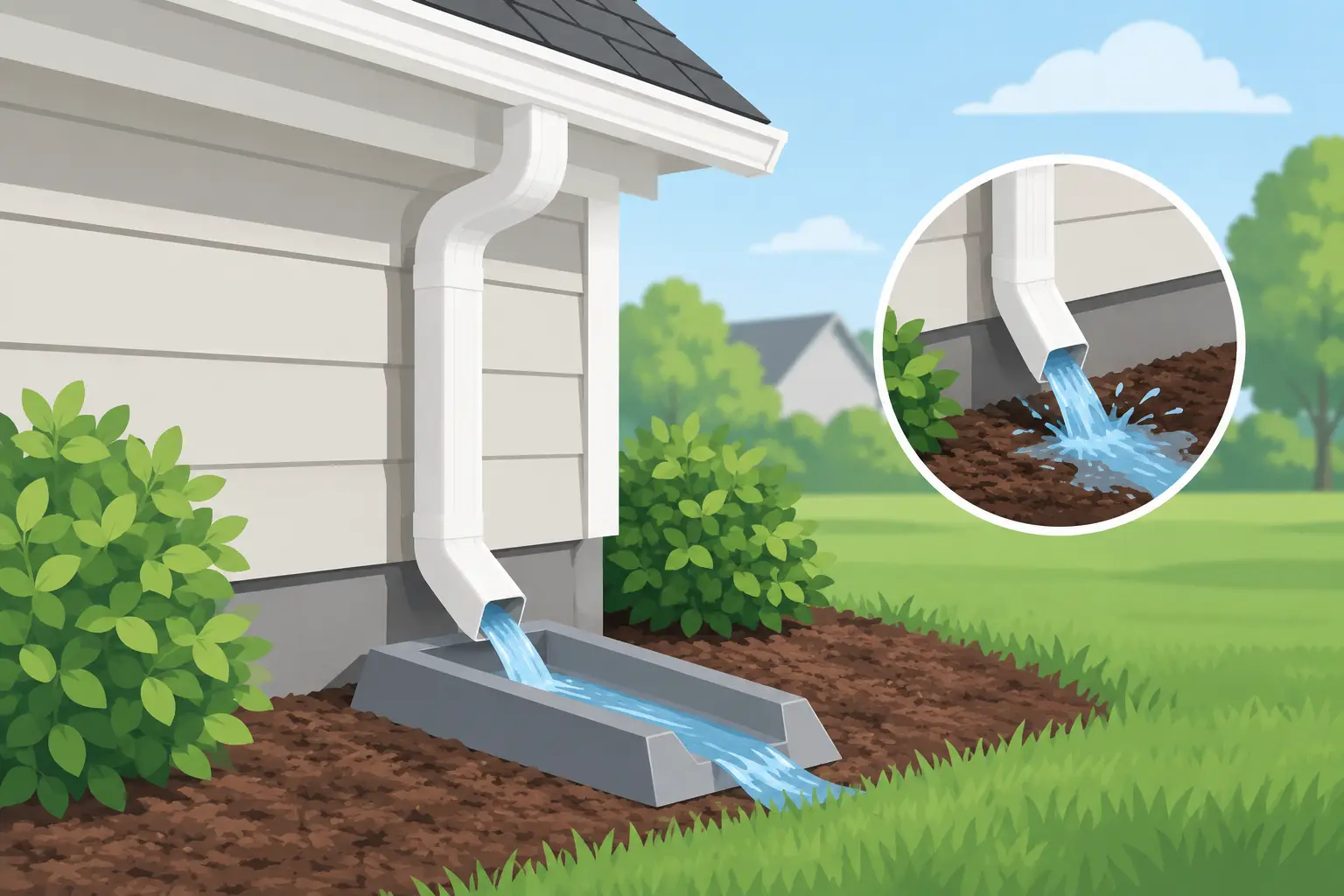
Downspouts are where the system actually drains. A long gutter run with one downspout at the end is more likely to overflow during intense storms. Adding a downspout or relocating one can make a bigger difference than changing guard style.
Incorrect pitch or sagging
Gutters need consistent slope toward the downspouts. If sections are flat, backpitched, or sagging between hangers, water sits and debris settles. Then the next heavy rain hits, the standing water slows everything down, and overflow shows up at the lowest point.
Debris builds up on top of the guard
Even great gutter guards still require occasional attention. In heavy rain, a thick layer of wet leaves on top can behave like a sponge. Water may still get in, but not quickly enough to keep up with the downpour, so it rolls over the front edge.
Valley and corner “blast zones”
Roof valleys concentrate runoff. During a storm, valleys can dump a high-velocity stream into one short section of gutter. Guards need to be matched and installed with those high-volume areas in mind, and sometimes the best solution includes a larger gutter, an extra downspout, or a redesigned drop outlet placement.
What to look for if heavy rain is your main concern
If your goal is to stop clogging without creating overflow headaches, focus on performance details, not marketing claims.
A guard that does well in heavy rain should sit securely, maintain its shape, and provide fast water entry even when the roof is dumping water at speed. That usually means a rigid system that’s anchored well and supported continuously so it does not bow or lift over time.
Installation matters as much as product. The guard has to be integrated with the gutter edge cleanly, aligned correctly under the drip edge when appropriate, and installed on a gutter system that is properly pitched and firmly supported. If your gutters are already borderline – loose hangers, slight dips, undersized downspouts – adding guards can expose the weakness faster because storms don’t give the system any margin.
If you are comparing options, it’s fair to ask a contractor two direct questions: how this guard handles high-volume roof runoff, and what they will check in the existing gutter system before installing it. If the answer is vague, that’s your warning sign.
A realistic expectation: guards reduce cleaning, not responsibility
Gutter guards are not a “never think about it again” product. They are a “much less often, much less messy” upgrade.
In our region, spring pollen, summer storms, and fall leaf drop all add material to the roof. Even with guards, fine debris can accumulate over time, and the top surface can need a quick clearing in peak leaf season. The difference is that you are usually clearing the top, not digging compacted sludge out of the trough.
If you want the system to perform in heavy rain year after year, plan for occasional checkups. That can be as simple as a visual inspection from the ground during a rainstorm. If you see water shooting over a specific corner every time, that spot is telling you something: a pitch issue, a concentrated runoff point, a downspout bottleneck, or debris buildup.
When gutter guards are a smart move in Eastern Indiana and Western Ohio
Guards tend to pay off fastest when you have mature trees, clogged gutters have already caused problems, or you simply don’t want to climb ladders. They also make sense if you are investing in new seamless gutters and want to keep that new system performing without constant cleanouts.
The best time to add guards is when the gutters are being installed or corrected, because the installer can address slope, hanger spacing, downspout placement, and trouble spots at the same time. Retrofitting can still work, but only if the existing gutters are truly in good shape.
If you want a clear, no-pressure look at whether your current setup will handle a guard upgrade and heavy rain, Seamless Gutter Solutions LLC offers free inspections and estimates with detailed, itemized quotes and no hidden fees – which is exactly what most homeowners want when they are trying to avoid surprise add-ons.
The bottom line during a downpour
Heavy rain is the moment of truth. The right gutter guards can absolutely keep leaves and debris out without choking off water flow, but they don’t magically fix undersized gutters, poor pitch, or limited downspout capacity.
If you’re deciding based on fear of overflow, focus on the system first: correct sizing, solid support, proper slope, and enough downspouts for your roof. Then choose a guard built for high-volume intake and installed with the same care.
The next time a storm rolls through Richmond, Muncie, Greenville, or anywhere nearby, step to a window and watch where the water goes. Your house will show you what it needs – and once it’s set up right, you can let the rain do its thing without worrying about what it’s doing to your foundation.